A Scholar’s Paraphrase · The Whole New Testament · Free to read

Every underlined word
is an invitation.

The Greek, the history, the covenant threads — opened inside the reading, at the word, right where you are. No account. No wall.

Read it freeSee a page ↓
“Where it all begins: the good news of Jesus the Anointed One, the Son of God.”Mark 1:1 · The Living Word
Don’t leave the text to study the text
LukeChapter Fifteen · The Father Who Runs
20So he got up and set out for his father. But he was still a long way down the road when his father caught sight of him — and something broke loose in his gut, a flood of compassion. The old man took off running, threw his arms tightly around his neck, and kissed him. [The father is watching the road. He has been watching the road — not just today, but for as long as it has taken, every day, looking down the same horizon… read more]
Tap any underlined word — this page is live.
God’s Action VerbStrong’s G4697
His Gut Twisted with Compassion — Esplanchnisthē

Esplanchnisthē — aorist passive of splanchnizomai: was seized from deep in the gut, moved with visceral compassion. The word comes from splanchna — the viscera, the internal organs, the bowels. This is not polite sympathy or measured emotional response. It is the kind of feeling that rises from the deepest interior and cannot be suppressed. In the Hebrew scriptures the word for this kind of compassion (rachamim) is bound to the word for the womb — the compassion a mother has for the child she formed and carried. The father’s response to seeing his son while he is still far off is gut-deep, womb-deep, impossible to restrain.

BDAG §4697; Matthew 9:36; Mark 1:41; Luke 7:13; 10:33; 15:20; N.T. Wright, Jesus and the Victory of God (SPCK, 1996), ch. 6

Not a mock-up — the page itself. Tap another word. Read the whole chapter — free →

The app · parchment by day, deep ink by night
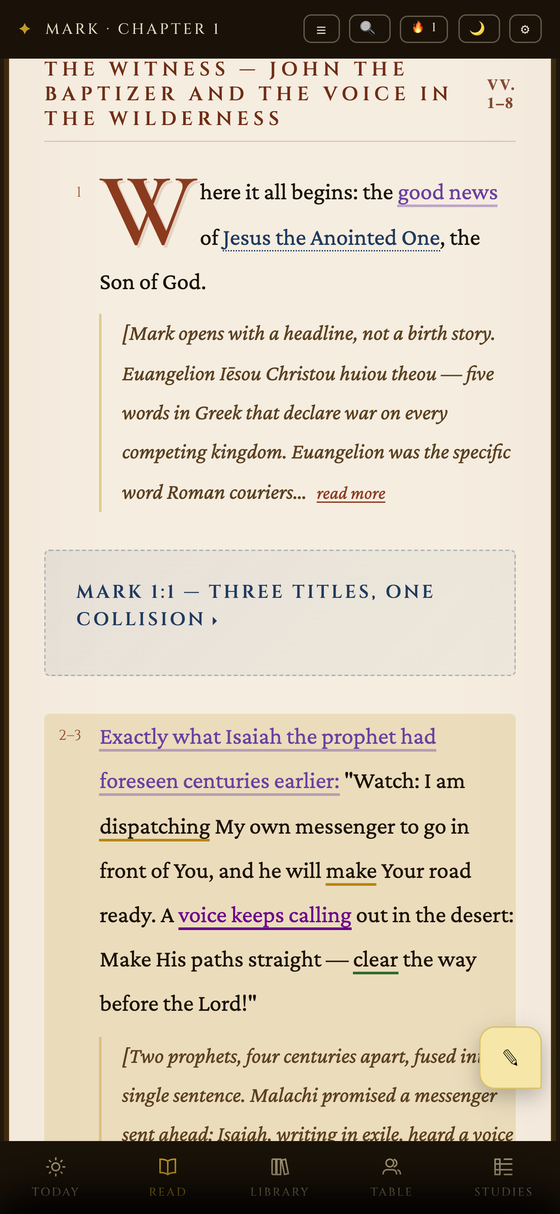
Mark 1 open in the app
The page
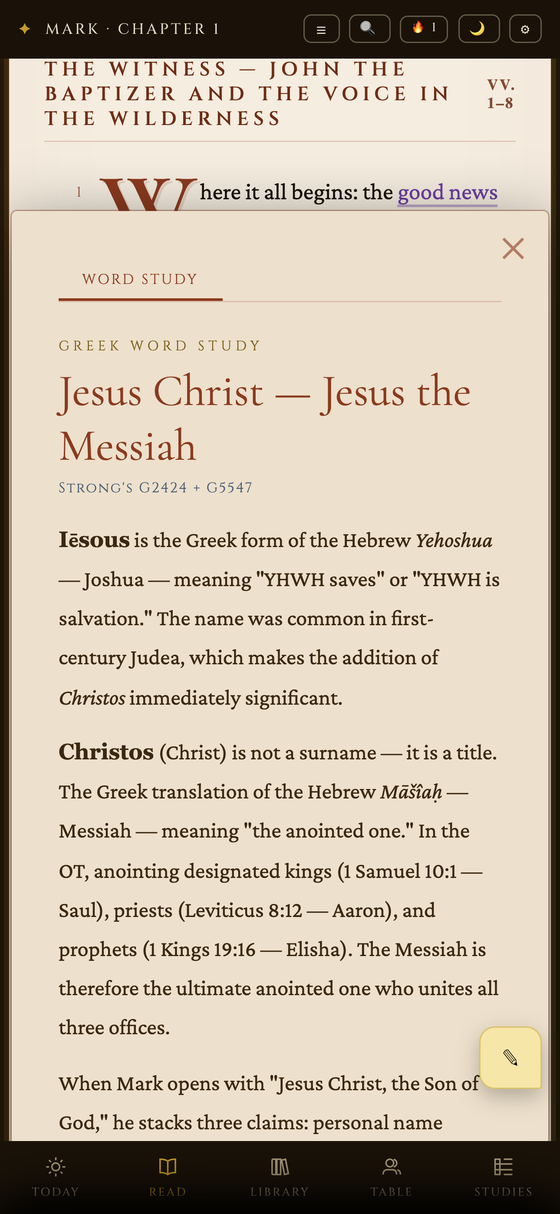
A Greek word study open
Tap a word — the Greek opens
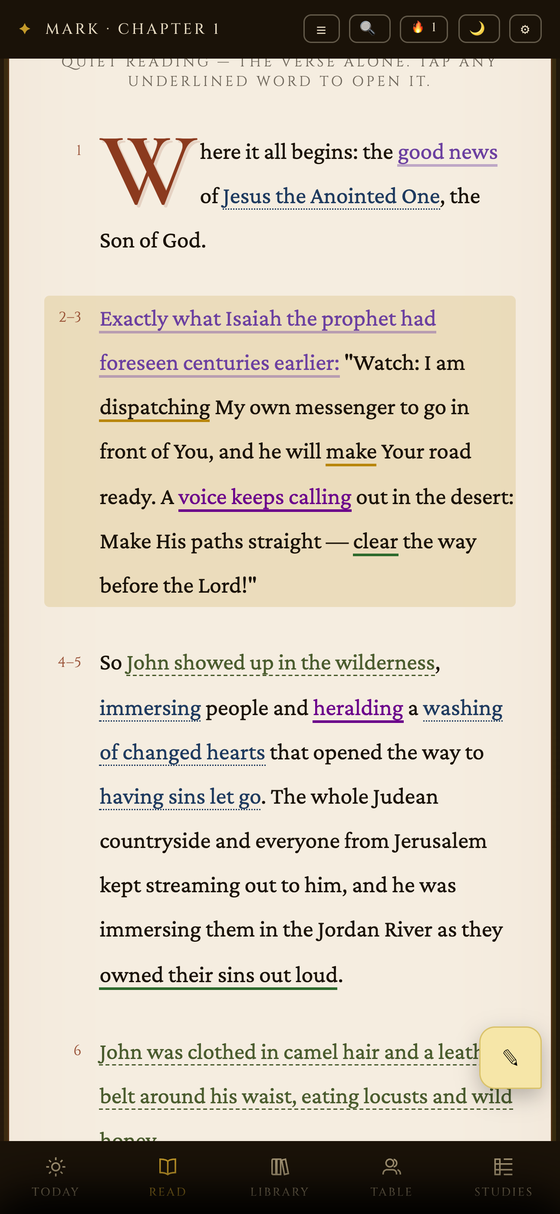
Quiet reading
Or just read — Quiet reading
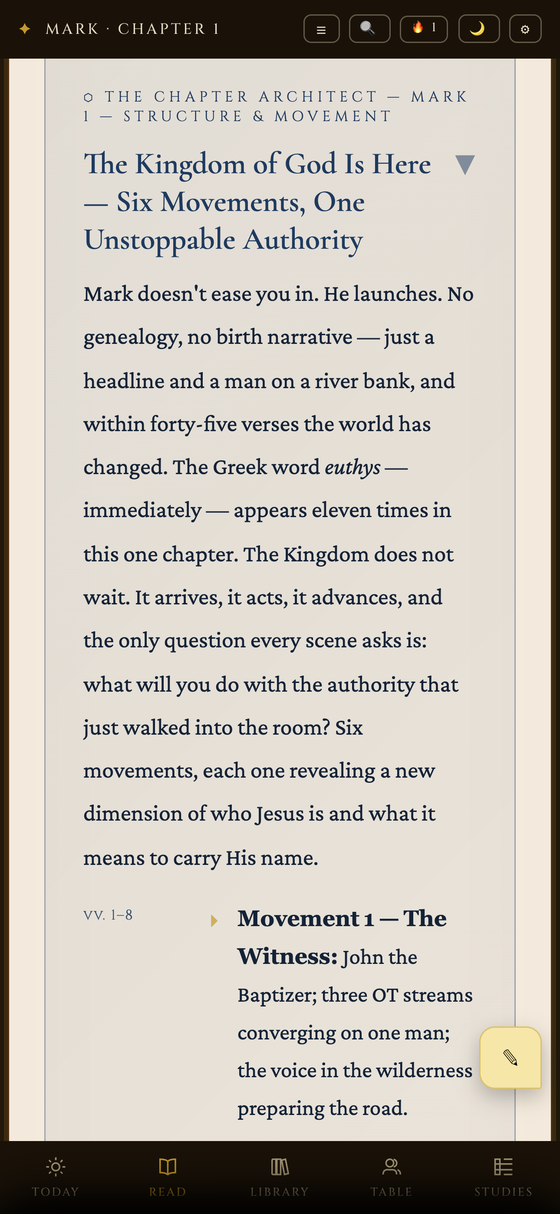
Chapter Architect
See the chapter before you read it

What makes it different.

Chapter Architect

See what the chapter is doing before you read it.

The movements, the themes, the centre of gravity — a map before you enter the passage.

Word Study

Meet the Greek behind the English.

The word, its full range, its Hebrew echo, and why it matters in this sentence — at the moment you ask.

Scholar’s Notes

Scholarship without leaving the page.

Woven in after the verses they open. The first note in every chapter is free — a taste before anything is asked.

Your reading

Notes, highlights, bookmarks. Yours.

Unlimited, free, on your own device. A quiet stone for each day in the Word — no badges, no red dots. Paper, paper-white, night or high contrast, at your size.

How the work is grounded

Depth you can check.

From the Greek. The SBL Greek New Testament is the base text — not another English translation. Where manuscripts disagree, the note says so.

Anchored. Definitions from BDAG and Kittel. Where a word carries a range English can’t hold, you are shown the range.

Documented. Josephus, the Mishnah, the Dead Sea Scrolls, the Septuagint — sixty-one sources, cited at the point of use.

Checkable. Published without the author’s name, on purpose: every judgement is meant to be traceable without knowing who made it. Why, in full →

Read the full method — from the Greek, and every judgement left checkable

From the Greek — and every judgement left checkable.

A paraphrase is only worth as much as the work standing behind it. Here is the work.

From the Greek, not from another English translation.

Every verse was rendered from the Greek New Testament, working from the SBL Greek New Testament as the base text. Where the manuscripts disagree, the Nestle-Aland and UBS critical apparatus were consulted — and the disagreement was not quietly resolved. It was written into the note, where you can see it.

The lexical work is anchored, not improvised.

Greek definitions come from BDAG — the standard scholarly lexicon of New Testament Greek — supported by Kittel's Theological Dictionary of the New Testament. Where a word carries a range that English cannot hold, you are shown the range rather than handed someone's choice from within it.

The world behind the text is documented.

What a first-century reader heard is reconstructed from what survives: Josephus, the Mishnah, the Dead Sea Scrolls, the Septuagint, Second Temple literature, and the archaeological record. Sixty-one scholarly sources, cited at the point of use — not gathered into a bibliography no one opens.

Where scholars disagree, you are told they disagree.

A note that presents a contested reading as settled has done you a disservice. Where the manuscripts diverge, or a rendering is genuinely arguable, or a traditional translation carries an assumption worth examining, the text says so and shows you the alternative.

On the names behind this work

This paraphrase is published without the author's name attached. The reasoning is set out plainly in About, and it is not a claim to authority by anonymity — it is the opposite. Every judgement in this text is meant to be checkable without knowing who made it. The Greek text is named. The lexicon is named. The sources are named at the point they are used. If a rendering is wrong, the apparatus needed to prove it wrong is on the same screen as the rendering.

Reading is free. It stays free.

That is a conviction, not a strategy — the Word was given freely and belongs to everyone. The deeper study layers and every conversation with Ezra cost real money to build and run; the subscription covers that honestly, and keeps the reading free for the person who can’t pay anything.

The Word
Freeforever

Every chapter. Word Study and Covenant Thread. The Chapter Architect. The first Scholar’s Note in every chapter. Unlimited notes. Day and night. Ezra opens the Word.

Read free →
The Student
$6.99/month · $69.99/year

Every Scholar’s Note. The Reign Word, the Equipment Thread, The Code. Ezra talks it through. All five study templates. Full Talking Reading. Study Edition PDF.

Open The Student →
The Table
$24.99/month · $249.99/year

Everything in Student for up to fifteen people — members never pay. Verse-pinned voice notes, a shared library, a session-guide builder. For groups ↓

See The Table →
The House
Let’s talkchurches & institutions

Everything in Table at scale, for a church up to 200. The congregation seen only in aggregate — the shepherd sees the flock, never through anyone’s window.

Write to us →

All prices in US dollars (USD). Subscriptions renew automatically until you cancel — in your App Store or Google Play settings if you subscribed in the app, or by writing to info@emmausroadpublications.org if you subscribed here. Annual saves two months on Student, a third on Table and House. Terms.

The rest of the story — open what you need
Exactly where the line sits — every layer, free or Student

The Word was given freely.
It belongs to everyone.

Reading The Living Word is completely, permanently, no-account-required free. Every verse. Every chapter. Every amplified bracket. Every Greek and Hebrew Word Study. Every Covenant Thread. Every Chapter Architect. Four reading surfaces. Font size control. Basic search. Unlimited notes, highlights and bookmarks — your own words are never metered. Verse cards to share.

Because the Word was given freely — and it belongs to everyone. Matthew 10:8.

And we will always show you exactly where the line sits. Every layer stays visible as you read — the deeper study layers open with Student:

LayerFreeStudent
Full verse text + amplified brackets✦ Open✦ Open
Word Study — the Greek & Hebrew✦ Open✦ Open
Covenant Thread✦ Open✦ Open
Chapter Architect✦ Open✦ Open
Reign WordStudent✦ Open
Scholar's NotesStudent✦ Open
Equipment ThreadStudent✦ Open
The Code — verb coding revealedStudent✦ Open

No hard walls. No pop-ups mid-verse. A locked tab simply shows what it holds and offers the key.

Five ways to study — guided by Ezra

Each template is a different posture
before the text.

Every template is guided by Ezra — a study companion who knows the chapter you are in, asks the question you need, and never fills in your answers for you.

"Ezra was the scribe and scholar who opened the Book of the Law to God's people — explaining its meaning so they could understand what they heard. Your guide here carries his name."

Available from $6.99/month — or $69.99/year, two months free.

What Ezra will not do: write your study for you. It has no answers of its own to push, it works only from the chapter open in front of you, and when you stop, it stops. The examples below show the kind of question it asks — they are illustrative, drawn from Mark 1, not a script.

◎
Open Study
When you do not yet know what you are looking for

A blank page beside the chapter. Nothing prompts you, nothing structures you, and there is no destination you are being walked toward. You read, and when you want to think out loud, Ezra is there — working from this chapter, not from the internet and not from a general knowledge of the Bible. Ask nothing and it stays quiet.

Ezra might ask“You have stopped twice at ‘I am willing.’ Do you want to stay there, or keep moving?”
You leave with whatever you actually found — written down, dated, and yours.
⚑
The Proclaimer's Study
You are preaching or teaching this passage

You work the chapter with Ezra — its movements, the Greek under the load-bearing words, the thread running back through the Old Testament. It will not hand you an outline, and that is deliberate: a message you were handed is a message you cannot defend. It keeps pressing on what the passage actually says until you can put it in one sentence.

Ezra might ask“You have said three times that Mark 1 is about authority. Which verse is carrying that? Show me the word.”
You leave with a message you can defend from the text, with every source attached to the point it supports.
✦
The Personal Journal
No audience — an ordinary Tuesday

Private, dated, yours. Nobody sees this — not a group leader, not a pastor, not us. Ezra asks one question and then gets out of the way, because this is the one study where being asked a second question would be an intrusion.

Ezra might ask“The leper did not ask whether Jesus could. He asked whether He wanted to. Is that your question this week?”
You leave with a record you can read back in a year and see what He was saying to you the whole time.
◯
The Group Session
You lead a group and Thursday is coming

Ezra builds the discussion out of the chapter itself, not out of a curriculum written for a generic group that is not yours. Start by choosing the shape of the session — Walk the Chapter for a group reading straight through, One Verse Deep for a group that would rather go far into a little, or Question-Led when there is a live question in the room. Each one carries its own four steps.

Ezra might ask“Two of your people are new to this. Want an opening question that does not assume they know who John the Baptist is?”
You leave with a session guide you could run tonight, built from the passage your group is already in.
◈
The Scholar's Study
You want the whole apparatus, in order

Every word study, every thread, every source the chapter carries — laid out in sequence rather than found by tapping. Ezra will not let you settle for the first reading that sounds right, and where the manuscripts disagree it shows you the disagreement instead of quietly picking a side.

Ezra might ask“You are treating euthys as a stylistic tic. Mark uses it more than the other three Gospels combined. Want to test that?”
You leave with the chapter mined — and a list of what you could not resolve, which is often the more useful half.
Alone, in a group, or leading a church

However you come to it — alone, in a group, or leading a church.

The same New Testament serves all three. What changes is what you need from it, and what it costs is shaped by how many people you are bringing with you.

If you read
The whole New Testament, free, with the work shown.

No account. No trial. No sample chapter. Open it and read — every verse, every amplified bracket, every word study, every covenant thread. The Word itself is never behind a payment, and it never will be.

  • Tap any underlined word and the Greek opens where you are
  • Notes, highlights and bookmarks — unlimited, never metered, stored on your own device
  • Read it, or have it read to you
  • The first Scholar's Note in every chapter is open to everyone

The Student subscription opens the long-form Scholar's Notes — the years of work standing behind each chapter — with the study templates and export.

Free forever · Student $6.99/month or $69.99/year
If you lead a connect group
Everyone in the same text, at the same depth, between meetings.

A group where everyone reads a different translation is a group having three conversations at once. The Table puts your people in one text — and lets them talk to each other inside it, on the days you are not in the room.

  • Members never pay. You subscribe; they scan a code and they are in
  • Word & Voice — ninety-second voice notes pinned to the verse that prompted them
  • Build the session guide from the chapter itself, not from a separate book
  • Accountability, if your group wants it — each member turns their own progress sharing on, and it stays off until they do

Fifteen seats. It pays for itself at four people — past that, you are bringing your whole group along for less than they would each pay alone.

$24.99/month or $249.99/year · up to 15 people
If you shepherd a church
You preach it Sunday. This is how it keeps going Monday.

Every connect group in your church reading the same text, aware of the same series, going as deep as each person is ready to go. You can see that your congregation is in the Word without ever seeing into any one person's reading.

  • Every group in the church under one subscription — members still never pay
  • Set the week's passage for every group at once, in step with the series
  • Congregation view is aggregate only — groups under five are suppressed entirely
  • New believers and seminary graduates in the same passage, each fed properly

Costs less per person than a printed study guide, and it does not run out at the end of the term.

Churches to 200 weekly · write to us
One text, every depth — nobody is written down to

The same chapter meets a person wherever they actually are. Nothing is simplified for one reader or withheld from another; the layers are all present, and each person goes as far in as they are ready to go.

Opening a Bible for the first time — every word opens the world behind it. Nothing assumed, no training required. Tap and it explains itself.
Studying Greek or Hebrew — the original languages are in the text, not in a separate tool you have to learn first.
Preaching on Sunday — sixty-one sources already synthesised before you open the chapter, and a template that walks you from the passage to the one thing your people need to hear.
Reading with decades behind you — the text you have given your life to, opened further than you have seen it opened before.
An ordinary Tuesday, no audience — just the text, and what God is speaking into this specific life today.
Sceptical, or still deciding — no agenda and no structure. Follow the evidence where it goes.

“The shepherd sees the flock — never through anyone's window.”

Our privacy standard, written before the first line of code
What a group leader sees — and what a pastor sees

What a group leader sees — and what a pastor sees.

Two different jobs, two different screens. Neither of them shows you what any individual person is reading.

How these will look. The Group Portal and the Congregation View arrive with the app, and the figures below are illustrative rather than live. The reading page further up this site is the opposite — that one is not a mock-up, it is the page itself.

The Table

Your group, between meetings.

Group Portal · The Table 11 of 15 seats
Voice note · Mark 5:34 · 1:12
“Daughter, your faith has healed you.” — someone in your group stopped here on Tuesday night and left this for the others.
Verses that received voice notes this week7
Shared studies and session guides4 · 2
Session guide — built from the chapter itselfMark 1
Invite by QR, link or 6-character codeMembers free

Accountability is theirs to switch on. Plenty of groups want it — being known is half of why people join one. So each member can share their own progress with the group, and many will. What makes it accountability rather than monitoring is that it stays off until that person turns it on, and they can turn it back off without asking anyone.

Accountability and surveillance are not the same thing. One is asked for by the person being held; the other is done to them. The Table does the first, and the conversation carries on inside the text on the days you are not in the room.

The House

Your whole church in the same text.

Congregation View · The House This week
Next Sunday · series: The Kingdom Arrives
Mark 2 — put every group in it
Set for all 12 groupsOne tap
Groups already walked this week's passage9 of 12
Study notes for Mark 2 — built from the chapterReady
For context, not for the pulpit
143of 200 people using the app read this week
61%read Sunday's text before Sunday
12groups active

Look at what is not on this screen: not one name. No individual's reading, notes, highlights or questions appear here — not to you, not to a group leader, not to us. Every figure is a total. Groups smaller than five are not shown at all, because in a small group a total is a name.

You can tell that your congregation is in the Word without ever being able to tell who has fallen behind.

How groups join — leader subscribes, members scan

Leader subscribes. Members scan.
No payment from members.

Leader subscribes
→
Portal generates QR code + invite link + 6-character code
→
Put it on the screen, in the bulletin, in the group chat
→
Members scan
→
Create free account
→
Full access instantly

No payment from members. No pricing page. Just a scan.

And once the group is in, Word & Voice begins: prayers, encouragement, and ninety-second voice notes pinned to the very verses your people are reading — a group that speaks to each other inside the text itself.

Why it is here before it is in the stores

We would rather put it in your hands now.

This is our life's work. Years of it, verse by verse. The New Testament is finished — all twenty-seven books — and it is on this site today, free to read, because we did not want to hold the Word back until everything around it was ready.

The apps are the part still in motion. Apple and Google each review on their own schedule, and we would rather tell you that plainly than post a date we cannot keep.

When they are approved, we will say so in two places — here, and on Instagram.

Follow for the release date
@thelivingword.asp

Please follow — it is the fastest way to hear the day it goes live on Google Play and the App Store. Until then, everything the app will open with is already here, and already yours.

On your phone in thirty seconds.

The Living Word installs to your home screen from the browser — no App Store or Google Play needed today. It works offline, and every new book arrives on its own.

The step-by-step guide
  1. Open Safari and go to the-living-word.org.
  2. Tap the ··· button at the bottom of Safari, then tap Share.
  3. In the Share sheet, tap Add to Home Screen.
  4. Name it anything you like. Tap Add in the top right.
  5. Open The Living Word from your home screen. The Word is open — no code, no account.

Open the site in Chrome, tap the ⋮ menu, then Install app (or Add to Home screen).

In Chrome or Edge, click the install icon at the right end of the address bar.

iPhone Open in Safari · Share · Add to Home Screen
Android Open in Chrome · ⋮ · Install app
Desktop Chrome or Edge · the install icon in the address bar
The reading experience

What you see when you open a chapter.

Every chapter begins with the Chapter Architect — a structural map: the movements, the themes, the theological center of gravity, and what to watch for before you read a single verse. Written by someone who spent weeks in the Greek of that chapter.

Then the text begins. Color-coded highlights mark every word that carries weight:

  • Navy italic, dotted — Greek or Hebrew word study
  • Purple — Covenant Thread
  • Deep green — Reign Word
  • Olive, dashed — Cultural context
  • Red, dashed — Political and historical

Verb underlining tells you who is acting: Gold — God is moving. Green — you are. Pink — faith. Purple — spoken word.

Woven throughout: Scholar's NotesStudent — extended theological commentary placed directly after the verses they illuminate. Not in a sidebar. Right there in the reading.

And at key moments: the Equipment ThreadStudent — the theology made yours. Closing with a declaration you can speak aloud.

Everything above stays visible as you read — nothing is hidden. The deeper layers marked Student open with a subscription; the reading itself never costs anything.

What it is

Not a commentary. Not a study Bible.
The scholarship is inside the text.

Most Bible tools put the scholarship beside the text — a footnote, a sidebar, a separate window you have to open, search, and close.

The Living Word puts it inside the text — at the word, at the moment, right where you need it.

Every highlighted word or phrase is a door. Tap it and the world opens:

  • The Greek or Hebrew root — its full semantic range, what the English alone cannot carry
  • The Covenant Thread — the same promise tracing from Genesis through to this verse
  • The Cultural Context — what the first readers understood the moment they heard it
  • The Reign Word — your authority, your identity, your inheritance in ChristStudent
  • The Political and Historical world that gave the text its dangerous edge

Built on 61 scholarly sources — BDAG, Kittel's TDNT, the Dead Sea Scrolls, Josephus, the Mishnah, N.T. Wright, Wayne Grudem, Gordon Fee — synthesized into a living, immediate, present-tense voice that takes the Greek seriously and the reader seriously at the same time.

A teenager and a seminary graduate can sit with the same passage and both go as deep as they are ready to go.

Reading is free — where the line sits

The Word was given freely.
It belongs to everyone.

Reading The Living Word is completely, permanently, no-account-required free. Every verse. Every chapter. Every amplified bracket. Every Greek and Hebrew Word Study. Every Covenant Thread. Every Chapter Architect. Four reading surfaces. Font size control. Basic search. Unlimited notes, highlights and bookmarks — your own words are never metered. Verse cards to share.

Because the Word was given freely — and it belongs to everyone. Matthew 10:8.

And we will always show you exactly where the line sits. Every layer stays visible as you read — the deeper study layers open with Student:

LayerFreeStudent
Full verse text + amplified brackets✦ Open✦ Open
Word Study — the Greek & Hebrew✦ Open✦ Open
Covenant Thread✦ Open✦ Open
Chapter Architect✦ Open✦ Open
Reign WordStudent✦ Open
Scholar's NotesStudent✦ Open
Equipment ThreadStudent✦ Open
The Code — verb coding revealedStudent✦ Open

No hard walls. No pop-ups mid-verse. A locked tab simply shows what it holds and offers the key.

Built for how you actually read

The app works around you —
not the other way around.

Four reading surfaces
Paper (the parchment), paper-white, night, and high contrast — every surface carrying the same ink strength, nothing thinned to look moody. Choose in Settings.
Font Size Control
Adjust the text size with a + or − tap. Your eyes, your pace, your experience.
Days in the Word
A quiet count, and a stone raised for each day — an Ebenezer, 1 Samuel 7:12. No badges, no red dots, no guilt. A week away earns “welcome back.”
Reading Progress
Your progress through each book shown as a percentage. See where you are. Watch it grow.
Your Study Workspace
Notes, highlights and bookmarks — unlimited, never metered, and stored on your own device. Export them to a file whenever you like.
A Person Reads Your Mail
Write to info@emmausroadpublications.org and a person answers. And if Ezra ever gets something wrong, flag it right under the answer — it drafts the email for you.

Read it. Hear it. Share it.
Carry it with you.

♫
Talking Reading
The Word read aloud — four listening modes: the verse alone, the verse with its amplified expansions, verse-by-verse with Scholar's Notes as commentary, or the Notes on their own. One chapter in every book plays free. Student unlocks every chapter, every mode.
✉
Verse Cards
Tap any verse and share it as a beautiful card — sized for Instagram, for a text thread, for anywhere. Every card carries a link back to the living chapter, so the person you send it to can walk through the same door. Student adds the amplified key phrase, the Greek word study, and Scholar's Note pull quotes to your cards.
⎙
Study Edition PDFStudent
Download any chapter as a print-ready PDF. The Reader Edition gives you the clean text with its amplified brackets. The Study Edition lays out everything — Scholar's Notes as block commentary, every tooltip rendered as numbered footnotes, the Equipment Thread at each section close, even your own notes in the margin.
🎙
Word & VoiceTable
For groups: voice notes up to ninety seconds, pinned to the very verse that prompted them. A member reads Mark 5, leaves a prayer on verse 34, and everyone reading that chapter finds it waiting. Encouragement that lives inside the text you share.